Monday, August 1, 2011

Week with Marcella: Day 1

While Marcella had sent us a basic idea of inspiration and design shapes for Aklala’s intended product development well ahead of time, it was clear that the week and the process couldn’t possibly start without first establishing a dialogue with Chantal, la fondatrice et creatice. So at 10 a.m. on Monday morning, the four of us convened around Ashley’s coffee table—me, loan facilitator Ashley, Marcella, Chantal, and baby Ashley—and began to share and discuss how to fuse Nest and Aklala’s design aesthetics, Chantal as a traditional Togolese artisan, and Nest as an American organization working with both women artisans from the developing world and western consumers.  Nest’s goal is to create an overall homogeneous collection of product that still respects and preserves the cultural particularities and identities of the artisans with which they work. To highlight what she meant Marcella brought out a large, standard tote bag from China that featured distinct handmade details.  Marcella explained to Chantal that this was an example of a modern bag designed and inspired by influences from Chinese culture.  The shape and colors were simple, respecting functionality and aesthetic preferences of western consumers, but the handmade details gave the bag its identity by allowing the artisans to express their culture through their craft.  That was what we want to do here; we’re going to start out with a simple and modern bag, but then let Chantal infuse it with her own perspective and creativity as a Togolese artisan.  Aklala’s new product line would be simple but relevant, because the last thing the western market and consumers need is another trivial factory product.   The goal is to create products that have intrinsic value in their design, that then become all the more noteworthy and competitive due to the meaning and significance behind them.
After the introduction to the process, Marcella began to show Chantal the shapes of various bags Nest would like to create, each simple and basic, so that the focus of the product is not on the design, as that’s not what’s significant about Chantal’s work, but rather in the details. For it’s in the details, in the batik, the beads and the wood accents that allow Chantal to express her own artistic identity; the shape of the bag can only set the stage for the main actors to come out and tell their story. Marcella then began to show Chantal some visual inspiration for design elements that could be adapted to reflect Chantal’s own preferences and artistic qualities. Using inspiration from Marcella’s suggestions, Chantal began sketching and taking down dimensions of the products that most interested her so that she could start sample production. Marcella told her that the goal is to get some product samples to take back with her to New York, but she didn’t want to rush Chantal or pressure her to complete more than she was capable of.  Quality, not quantity is so much more important, especially when you are dealing with developing artisans, and not factories.
This introduced another crucial element of Aklala’s product development: environmental sustainability.  It’s not solely about improving the physical look of the bags; making the entire production process more organic and environmentally friendly is just as important.  Artisans in the developing world are already extremely disadvantaged in western markets, so it is our job to help them be competitive by making their products and their processes as valuable as possible given their circumstances.  Marcella was very excited by the prospect of using local and organic vegetable dyes rather than chemical reactive ones.  While Chantal already knew the basic compositions of the dyes and colorings, she doesn’t currently have access to many of the necessary raw materials, and so for the moment she could only buy them from a supplier on Mount Kuma. In time, Chantal could train women in her community how to obtain the materials and make the dye, thus giving productive employment to non-seamstresses without other economic opportunities. The next step was coming up with more creative and interesting ways to recycle leftover batik scraps. Chantal currently uses scraps to make batik beads for jewelry and has experimented with using scraps to stuff stuffed animals, but she hasn’t had the time to develop many other alternatives.  Marcella showed her basic examples of interesting ways to manipulate scraps, and Chantal immediately began throwing out ideas of her own, she was especially intrigued by making floral motifs and patchwork shapes as product accents. I could see how excited Chantal had been about the whole process, even with baby Ashley fussing for most of the morning and some basic communication difficulties, Chantal left Ashley’s that morning confident and motivated for the week ahead. After lunch, we would meet up again in the afternoon with plans to show Marcella around Aklala’s workshop and start constructing a sample bag. 
The recent rain has pretty much destroyed the dirt ground of Chantal’s workshop, and she is still waiting for the men to come and lay the cement, so for the time being efficient and effective work is difficult. But that’s the unfortunate reality of working in the developing world, conditions are never perfect, and it just means that you have to work even harder and become more dedicated to succeed. Marcella wanted to start by looking at all of the raw materials and finished products, and meeting all of the women of Aklala. After basic introductions, Marcella asked Chantal to give the women a basic overview of what we had done this morning, and what our goals for the week and product development were. Chantal understood and explained everything Marcella wanted her to capture, even in Ewe, we could understand what she was saying when she held up the bag Marcella had used as an example earlier and said, “This is a bag we’re going to do, but we’re not going to do China, we’re going to do Togo.”  The women looked around and smiled; they got it too.
 Most of Chantal’s batik is bright and colorful, reflecting the vitality of Togolese life and culture, but she sometimes struggles to sell to western consumers due to their preference for functionality, practicality, and occasional blandness.  So while there is time and a place for this vibrant and beautiful batik, a practical everyday bag is not necessarily one of them. So we spoke with Chantal about ways to use the bright batik as accents, or for smaller specialty products such as cosmetic and computer cases.  Marcella was also very interested in other raw materials that Chantal had available to her such as leather, flour and cocoa sacks, beads, and wood pieces.  She assembled all of the product “ingredients” and then asked Chantal to pick what she liked and start creating something with them.  This was such an exciting process for Chantal, her eyes lit up and a smile took over her face, because previously, the creation process had been structured by following order requirements and specifications from the client. While following specific client demands is valuable practice in dealing with the exigencies of western consumers, it leaves little place for the development of artistic creativity. Marcella was very adamant that we let Chantal take control of the design development process, we would guide her in the right direction with initial inspirations, but we must let her express herself entirely without editing until the end, because editing too early stifles artisan creativity.  Even if Chantal got a little carried away, didn’t fully plan out all of the details before she started cutting, messed up one of the flour sacks, Marcella didn’t say anything, she just let Chantal work naturally so that she could understand her production process.
 The goal is not to change and revolutionize Chantal’s process of production to emulate western factory standards, but rather to refine it so that her products are of the highest possible quality given the handmade tradition.  We don’t want to tell her that what she’s doing is wrong, but that there are ways that she can be better and more effective with strategic planning, organization, and communication. We had initially asked Chantal if she would have been able to finish a sample bag tonight and she thought she could, but after realizing that she didn’t have all the materials she wanted, she had cut one of the bags wrong, and she still needed to work out the design, she said no. She said she wanted to take her time to make sure that the finished product was perfect.  Marcella was thrilled with this response because it reflects both Chantal’s better understanding of quality control and her empowerment to say no. Chantal has always had a very difficult time saying no to consumers, as she sees every consumer as an opportunity to help grow her business. While this planning for the future and a desire for expansion is positive, she wasn’t working with a knowledge of her own limitations, she would agree to do orders that were beyond her production capacity, and the customer would end up being disappointed in the long term, far offsetting the immediate benefit from the order. The process of product development is so instrumental that it needs its own budget, that provides that Chantal can design ahead of time, start to perfect these processes, and then build up an inventory stock so she can sell to larger organizations that can market and distribute her products on a greater scale.
That night over Awoyoos and Grenadine, an adult Shirley temple, Ashley, Marcella and I reflected on the entire process that we had started today. We all agreed how important this organic, reciprocal process is when working for the development of artisans worldwide. It must also be ensured that the input of the artisan holds equal currency as do western consumer preferences.  We can’t impose our own ideas and designs without Chantal’s input, for if that’s what we were looking for we might as well go to a factory, which could do it much more efficiently and effectively than she could. We need to combine our knowledge of western consumer preferences with her unique and cultural design aesthetic to provide a product that is not only modern and relevant, but that also holds significance for the empowerment of women and for the environment. In this way we are going beyond functionality and embracing cultural meaning and value. The cultural identity must be the starting point, so we can determine what resonates with Chantal and how she can express it with products intended for western consumption.
            Most people in the western world haven’t even heard of Togo, but Chantal wants to put it on the map with a handcrafted cultural story and expression. In this way more consumers will have an appreciation for small developing countries with a vibrant craft sector, and maybe some of the asymmetries of access and information will moderate. As consumers purchasing products from the developing world, it must be remembered that we are paying for the creativity process more than for the product itself. The purchase is paying for the development of women and the respect for their traditional artisan craft, not just for a tote bag.  


Tuesday, July 26, 2011

Marcella et les Marchés du Lomé

Marcella got here yesterday for the week in order to revamp product design with Chantal to make her products more marketable, practical, durable, and easier for large-scale production.  Marcella is such a fascinating woman and I’m so excited to learn from her and hear about all of her stories from her worldly travels and interesting job experiences. She’s originally from Colombia but has worked as a journalist, consultant, and designer and has had some of the most amazing life experiences.  I want her life.  When you are young, sometimes the best thing you can do is find the best leaders and follow them. So I’m going to ask her about her path taken, and how I can start out on my own. But before Marcella, which I’ll get to after this week, there was a day in the marches of Lome, which deserve their own mention. 
            Ashley had heard through the Peace Corps grapevine about the fetish market, a place where products for animism, voodoo, and fetishism join forces to supply for the traditional rituals of Togo’s ongoing animism adherents—a mere 40% of the population. We pulled up into the center of a large square, stalls framing both sides of the car.  The second our car drove into the market, young boys came sprinting out of back rooms through the aisles, hands outstretches, hissing and pointing.  It really freaked me out because even though I get hissed at all the time, it’s not like this, and it’s not in a fetish market.   Stepping out of the car the first thing that hit me was the stench.  I glanced around and it was then that I noticed all of the animal carcasses on the tables. There was a dead dog stretched out and drying on the ground a few feet away; I thought I was going to puke.  After extensive price negotiation, and some effective pouting by Ashley, we got the chief to show us around the market and explain some ancient rituals.  The primary way in which animism is still practiced is for medicinal purposes, and they grind up various parts of animals to remedy different illness.  The puffer fish, for example, is used to treat elephantitus, which seemed a little bit too obvious for me, but I’m not going to disparage African voodoo, because I’m not trying to get cursed. He spoke of how the warriors wear necklaces of python vertebrae to give them strength in battle, how devotion to fertility statues will protect against maternal mortality, and all about the magical properties of horsehair. It was creepy, but fascinating at the same time.  All the more interesting was that in the States, these practices would be written off as crazy and immoral cult rituals, but here, they’re not only accepted, but also given credence by a large portion of the population. Modern day medicine and healthcare, which access to is taken for granted in the west, hasn’t taken root in much of the developing world, partly because of a lack of access to adequate medical care in rural areas, as well as a lack of an ability to pay, so the poor have had to either make due with traditional remedies, or suffer in neglect. 


But I digress, and the fetish market was making me increasingly uneasy and nauseous, so Ashley and I decided to go to the grand marché to do some lighter shopping and to find lunch—vegetarian, for obvious reasons.  This was my second trip to Lomé’s market and so I was ready for it and not as completely overwhelmed.  Lomé’s market is like Kpalimé’s, but on crack.  It’s bustling and congested with people, goods, and cars, and navigating it is a nightmare if you don’t know where you’re going.  Thank god for Ashley.  But it also has the best variety of raw materials, pagne, food, jewelry, artisan craft, and most other goods imaginable. We found a woman to make us avocado sandwiches and then went to see the Mama Benz, women who sell huge quantities of pagne in the market, fittingly named because their success enables them to all drive Mercedes.  They have some beautiful prints, but what on earth would I do with 12 yards of fabric, as they don’t sell it in smaller quantities, and I’ve already stocked up on pagne in Kpalimé and batik from Chantal. So we left and went to Ashley’s hidden gem of a seamstress, who is making me clothes from all of the fabric I’ve bought.  Whoops.  I can’t wait though, she’s making me some amazing stuff and I’ll definitely post pictures, but it won’t be finished until the day before I leave.  


Right now I’m going over to Ashley’s to work with her, Marcella, and Chantal on our first session for product design.  Marcella said it’s going to be a very organic process, and we are going to try and look into using organic, locally composed dyes, sourcing other raw materials such as distressed leather and canvas, and try and simplify designs for Chantal so that she can perfect these bags and really start to build up an inventory stock.  I’m so excited and I know this week is going to be amazing. Tuesday we’re showing Marcella around the market here in Kpalimé, Wednesday I’m teaching the quality control curriculum I wrote, Thursday I’m conducting control group surveys, and Friday we’re spending all day at Chantal’s to finish up construction of all of the bags she’s going to be sending with Marcella to Nest as samples. I’ll keep you posted!

Wednesday, July 20, 2011

Centre Artisanal and the Pouring Rain

          There’s a raging thunderstorm going on around me, the power just went out, I think my ceiling is leaking, and thunder and lightning are reverberating through and illuminating my bedroom. Needless to say, I can’t sleep, so I’m going to take advantage of my current insomnia to blog about my trip to Kpalimé’s Centre Artisanal!  Monday was my first day with absolutely nothing to do.  Chantal was taking the day off for some much needed rest and relaxation, Emily left, and Ashley hadn’t come back from the states yet.  I was bored. After doing some morning honors thesis research and finishing the quality control curriculum, which I will blog about later, I got really really bored.  The town and tourists alike boast about the artisan center, and it’s something that I had always wanted to see because it contributes to Kpalimé’s identity and reflects its rich artistic tradition. So I caved and let Abalo, my neighbor who thinks he’s my boyfriend, take me there because I needed to go with a local so I wouldn’t get scammed and so I could communicate with those who didn’t speak French.
I was a little apprehensive about going because of what happened to Chantal’s father, and because I know it makes business difficult for unaffiliated local artisans due to its monopoly on tourists.  The center has the greatest variety of pottery, batik and woodwork to be found in one place, and tourists have no reference for how much the center marks up the price, nor do they have adequate information about alternative artisan workshops. Chantal has mixed emotions about the center as well that she had previously conveyed to me, saying that while she appreciates the fact that the center promotes artisan development and teaches skills, albeit at a high cost, it also takes away business from those who don’t want to get involved because it takes away many of their profits by charging high fees just to exhibit their work, or to those who can't afford to pay for the apprenticeships. 
The artisan center consists of workshops, classrooms, display rooms/stores, courtyards, and lodging facilities for those who come to learn from surrounding villages. We first passed by the pottery studio, and there was a lone woman sitting outside with purple hair polishing off a bowl with a flat stone.  She was excited by my presence, and she showed me the entire stock room of pottery, as well as the firing kilns, the glaze and then the store with all of her products for sale.  Pottery is challenging to sell because its fragility means high costs and efforts for transportation, often outweighing the benefit of purchasing it in the first place.  While many of her things were beautiful, it just wasn’t practical for me to buy anything since first of all I had no need for it and it second it wasn’t worth trying to figure out how I would fit it into my already stuffed suitcase, due to my overpacking and a shopping problems, a lethal travel combination.
      We moved on to the woodshop, where I was initially entirely overwhelmed because the room was jampacked with literally everything imaginable that could be produced from wood; jewelry, masks, animals, drums, toys, household items—and then some. To make matters worse, Abalo decided to be really annoying by pointing out EVERY single product and telling me what it was, as if I couldn’t figure it out for myself. When I stopped responding to him he found these numb-chuck like noisemakers and proceeded to whack them about while still following me around the entire store, until I snapped and told him to stop and shut up.  I felt bad for being mean and hurting his feelings so I took a mask off the wall and goofed around to cheer him up. It’s like I was hanging out with 2-year-old Gad rather than 21-year-old Abalo.  It was then that I noticed how amazing all of the handcrafted wooden masks were.  They were so intricate, so embellished and detailed, that for all of my friends who know my magpie ways and know how I can’t resist anything that sparkles and shines, this shouldn’t come as any surprise:  I bought a gold and silver one. Only after having a very taxing internal debate because I couldn’t decide between the one I bought and a black one with colorful beaded details.  
Because I was so impressed with all of the woodwork and because I got to tour the area where all of the artisans were working on their woodwork, seeing the batik shop after was such a letdown. To be fair, I’m spoiled because of my experience and exposure to Chantal’s work and quality, but even so the batik at the artisan center was so average and uninteresting, I felt almost ashamed that that’s what is representing Togolese batik to western tourists. I was guessing that asking them to pass out Aklala’s business card, for the sake of the craft, wasn’t really going to fly.
But that’s a major component of business and retail, determining who your biggest competition is and how to tap into their market share. While passing out business cards to the center’s customers would get me in a lot of trouble with the management, there are other, safer, ways to attract more local business and markets for Aklala. It’s going to be a big challenge to help them achieve a large enough community presence to the point where they can draw in tourists on their own behalf, rather than through existing volunteer connections. But we are determined to find as many outlets we can, advertise and market to local hotels, western NGOS and other artisans who wanted to support each other’s crafts. The craft industry is currently very fragmented; in part because of its diversity, but improving industry coordination may be a key lever to strategically address the other challenges facing the sector, namely helping all artisans gain access to western markets as well as build up local consumption capacity, but as per usual I’ll get into that later :)


Monday, July 18, 2011

Introducing the Women of Aklala Batik: Part 2

Chantal Donvide


Chantal is the oldest of 8 children and moved to Kpalimé from Benin when she was 5 years old with her family. Art is the common thread that unites every member of her family, and she takes pride that she can take part in this tradition that will be passed down for generations. After moving to Togo, her father, a farmer and sculptor of wood, partnered with a Frenchman to form the Centre Artisanal of Kpalimé, now one of the town’s leading tourist attractions. It was originally founded as a way to spread artistic knowledge and skill set training by offering craft apprenticeships. Finished student products were sold in the showroom, using a percentage of the profits to pay teachers and for centre development.  The Centre was becoming extremely successful when it caught the eye of the Togolese government who saw it as a potential revenue-generating project for the state.  Without any fair warning, explanation, or due process, Chantal’s parents were thrown into jail and the government seized ownership of the Centre.   While Beninese lawyers and government officials objected and were able to free her parents, her father decided to abandon the centre and focus on his own medicine and wood sculpting enterprises, seeing how public projects were easy targets for political corruption.  It is from that vantage that Chantal has always been inspired to start her own enterprise and become successful on her own terms, rather than do so in the government domain.
            Chantal started her apprenticeship as a couturier, but when she became pregnant with her first daughter, her doctors forbade her from using the foot-pedal sewing machines, forcing her to find another way to support herself and her future child.  With a grant from a western foundation she was able to afford to take a costly batik course to learn a new trade.  Chantal finished this introductory course in 1 month and then took unpaid positions at five different batik workshops in order to learn all of the available batik methods.  She could then combine the best of each to create her own unique aesthetic and process of production.   Now possessing the necessary skills and the ambition to start her own batik enterprise, she took out a loan from a local microfinance institution.   She had to give the bank a large security deposit amounting to a third of the total loan in order to be deemed eligible to borrow. Interest would accumulate depending on how long it took her to pay it off.   In order to showcase her newly produced batik products, Chantal took the opportunity to participate in a huge industry trade show in Burkina Faso. Still in need of start up capital and not wanting to take out another loan from the MFI, Chantal took out an additional loan from a relative of the existing Peace Corps Volunteer. The show was not as successful as she had originally intended, and while Chantal was able to pay off the microfinance loan, she still didn’t have enough money to pay back the additional money she borrowed in preparation for the trade show.  Luckily tourist season was coming along, and Chantal worked hard to find customers to buy her products and was able to pay everything back in full. 
It was at this point that Chantal became involved with Nest. Nest provided Chantal an interest-free microbartering loan to purchase raw materials and supplies to be repaid back in product.  Chantal was finally able to start to see the possibility of growth for Aklala Batik as a successful and sustainable enterprise, as all funds could be dedicated to the development of her business rather than to loan repayment.
Chantal and Aklala also greatly benefitted from Nest’s business training, whereby Chantal learned the importance of financial planning, marketing, western consumer preferences, and quality control. Kpalimé’s economy is for the most part seasonally determined.  In the summer months the influx of volunteers and tourists causes universal growth spurts, and it is this time when Aklala generates the most revenue.  Before Nest, despite Chantal’s success during the tourist season, she would struggle to provide for her family throughout other times of the year. Without markets in which to sell her goods, some months she wasn’t even able to take a salary for herself. Now with the added revenue and markets of Nest, Chantal is not only more supported in these “dead months” with orders from Nest, but she has learned from the business training how to understand the seasonal pattern of her sales, so she can save and prepare for them. During the summer months Chantal now puts away some profits into a bank reserve, so that during the dead months she can buy supplies in bulk and start building up her inventory stock. She also uses this time to train apprentices and focus on her product and business development.  When summer rolls around she has greater quantities of finished products to sell so that she can make more profits with increased demand. Chantal knows that she must develop her own capacity to direct, analyze, and improve her own business and she feels that the business training is giving her the capacity to do so.   After training, she started to develop a plan to construct a fully equipped workshop in order to better improve her efficiency and effectiveness in organization and production.
Recently Chantal’s husband lost his job, and the responsibility fell on her to be the sole breadwinner for the family.  Before Aklala and Nest, it would have been extremely difficult for Chantal to stay afloat and support her family on a typical woman’s seamstress salary. Now, while still challenging to be a one-income home, Chantal takes pride in her status as the primary and capable supporter for her family. She is aware that in Africa, women suffer more than men given the leading cultural mentality that women and young girls should be confined housework and it is the husband’s role to provide for them.  This little investment in girl’s education or economic advancement means that when a man loses his job, which frequently happens given the unstable nature of Togolese infrastructure and industry, a family suffers.  Women can, and need to be able to make money to support themselves and their families. This is especially true given the proven fact that women’s income generation is directly invested to improve children’s education, health, and community development.
Before the Nest loan, Chantal lived in a shared house with her siblings and all of their children.  In the past year she has been able to construct her own house, buy a big plot of land to start construction of her own workshop and storefront, install electricity, and begin plans for constructing lodging for her apprentices.  Her children, who used to go to inadequate public schools, are now enrolled in private school and with the help of private tutors, are in the top 5% of their class.  Beatrice, her oldest daughter, is in school studying medicine with the intent of becoming a doctor.   
Chantal doesn’t see Nest loans as loans, rather they are business investments that allow her to develop her production capacity and pave channels for market access by connecting her to western consumers and retail firms through ethical sourcing.  While it hasn’t always been smooth sailing, and she has experienced her fair share of difficulties, failures and set backs, Chantal knows that it is all part of the learning process of running and growing a sustainable business.  If poverty can be called the tyranny of emergency, Chantal now has insurance.  Not only can she pay for her own family’s medical expenses, for instance she just took her 5 month old daughter Ashley to get a number of vaccinations and immunizations, but she is also providing care for her apprentices and employees who need medical attention and can’t afford it themselves.  She has a stable income and savings, provides nutritious meals for her and employees and apprentices, and is building and improving the quality of her life. 
Chantal has seen how beneficial the Nest model has been to her life, and now she wants to extend its impact to help orphans and other disadvantaged women.  Chantal’s image in the community has changed, she has noticed that she is respected for being a woman who has started a successful business with new connections, clients, business and orders that is adequately providing for her family. With her newfound influence, Chantal wants to provide economic opportunities to women who already have the skill sets; they just don’t have fair access markets, capital or financial knowledge to improve their own livelihoods.  She is working towards getting to a production capacity that can manage large orders so that she can hire more apprentices, provide more employment and contribute to the development of the community as a whole.  She wants to empower women to realize their own potential and change the leading cultural mentality where they are confined to the domestic sphere and incapable of providing for themselves.  She believes in herself as both a businesswoman and as an agent of change in her community and she is hopeful about what the future will bring for her.   

Friday, July 15, 2011

Introducing the Women of Aklala Batik: Part 1

Akouvi Etiyaka


           Akouvi was born in 1990 and grew up in a slum near the village of Wahala.  She is one of eleven kids, 8 from her mother and 3 from another wife of her father.  Her father is a farmer but abandoned the family when she was young, and because her mother never went to school and was thus illiterate, she struggled to find a sustainable income.  Her mother took care of her children through community support and through the selling of charcoal and firewood. 
After 4 years of primary school Akouvi fell very sick with ear infections and was forced to leave school.  Like her mother she never got the chance to learn how to read or write, and because she couldn’t afford the right doctors or medications for treatment her illness has left her with severe hearing problems.  Having no economic opportunities because of her premature education termination she was forced to live and work with a family as a domestique. This was a very difficult time for her as she was mistreated due to her lack of hearing and she left at the age of 20.  Akouvi didn’t want to end up like her mother, she saw how her mother suffered throughout her life and she didn’t want her own life to only consist of housework and selling firewood and charcoal just to make ends meet.  She wanted to learn a trade so that she could support herself and her future family, one that she wasn’t ready for just yet. She moved to Kpalimé, knowing that her grandfather had a house where she could live in and knowing that Kpalimé is home to many artists and craft practitioners. Upon arrival Akouvi went to a local church to ask if one of the women in the congregation could help her find an apprenticeship, and a kind woman directed her to Chantal and Aklala.
Her grandfather helped to contribute to pay for the fee for her apprenticeship and provided her with a house to live in along with other family members, but she is still completely independent and must provide for herself. As an apprentice, she is not at the stage where she can make any income, so she continues to sell firewood and charcoal to pay for basic living expenditures beyond what she is given at Aklala. Akouvi is very appreciative of the opportunity to learn a trade and be able to support herself, the way she sees Chantal and Liza currently doing.  Even though she is having difficulty in some of the processes of production because of her illiteracy, such as following measurements for dye compositions and following instructions for different bag requirements, she is so grateful for how welcoming Chantal has been.  After Akouvi finishes her apprenticeship she one day hopes to open her own batik workshop, so that she will have a stable and structured income, something her mother could only dream of.


Beatrice Kpodjagor


Beatrice is the oldest daughter of Chantal, born in 1992 and has been learning to sew from her mother since the age of 9.  Her father abandoned them when she was just a baby, so she has seen how hard her mother has had to work to establish herself as a successful entrepreneur. Through Chantal’s business endeavors, she has been able to pay for Beatrice’s private schooling including private tutors, and she is now only 1 year away from graduating high school before she will proceed onto medical school.  Beatrice’s grandfather is an herbalist who practices traditional medicine and Beatrice has always taken great interest in his work and she wants to help him by combining the traditional healing methods with more modern practices and studies. 
During vacation and after school during the year Beatrice works for Aklala to contribute as a sign of her gratitude that her mother has put her through school and allowed her to follow her dreams of becoming a doctor.  There aren’t many young girls in Kpalimé who can afford to pursue careers in the medicinal field and she feels very lucky that she is able to do so.  She sees the ways in which her mother wants to help the community by giving employment to orphans and disadvantaged youth and that has inspired her to also give back, but in her own way and with her own set of interests.  She wants to be able to establish herself in the field of medicine so that she can offer free health care services to some of the region’s most needy.  
  
Liza Ahoussou


Liza was born in 1975 and grew up in the villages of Badou and Notse, where she was 1 of 8 children, only one of which is from her biological mother. Soon after completing secondary school her parents passed away, and Liza decided that in order to support herself she would learn a trade instead of continuing on with additional schooling.  After a batik apprenticeship, Liza took out a loan from a local Christian Microfinance Institution in order to buy raw materials and supplies for batik that she would sell in Burkina Faso.  Her plan was to sell all of the pagne she made in Burkina Faso and use some of the revenue to pay back her loan once she returned.  However, her pagne didn’t sell as she expected it would, as not many can afford to buy handmade and original batik, and she had to lower the price in order to sell enough to pay back her loan.  This meant that she wasn’t getting as much profit for the sale of her product as she had hoped, and all revenue, rather than just a portion, was going towards repayment. When she couldn’t meet the full payment, she became indebted to the institution and was forced to come back to Kpalimé to sell her pagne. She then had to pay the bank back at a monthly rate, now with high interest rates.  After paying back her loan in full, with little money left over for herself, she had trouble finding a position as a batiker, as not many businesses could afford to hire her and adequately compensate her for her work.  She found a piecework position in Ghana, but the matron only gave her enough money to reimburse her for transportation costs, not paying for the work she was actually completing.
After being hired by Aklala and working for enough time to start earning a profit, she was finally able to pay back all of the debts she had been accumulating to friends, family and other people in the community. Without parents who could provide for her, Liza had had to borrow a lot of money to support herself. She is very happy now because she has found a stable and steady income, where she doesn’t have to worry about how she is going to survive from one day to the next.  What is more, she also feels like she has a system of support at Aklala because Chantal takes care of her by providing her with food, medical expenses and other essential living expenditures, and will give her payment advances if she needs it in extenuating circumstances.
                Liza's own experiences as an orphan and having to grow up and independently support herself, has committed her to serving fellow orphans and disadvantaged youth through Aklala’s proposed free apprenticeship program.  She wants to help provide for those who otherwise wouldn’t have any economic opportunities by teaching them a trade and allowing them to provide for their own well-being, rather than constantly relying and being dependent on the support of others. She wants to use herself as an example to demonstrate the power of financial success and independence to liberate the poor from debilitating poverty.


Thursday, July 14, 2011

Ups and Downs of Monitoring and Evaluation


        Today I conducted the first part of the Nest Monitoring and Evaluation surveys and gathering testimonials for 4 of the women at Aklala. Due to the recent nature of Aklala’s business development, there has been a lot of employee turnover as Chantal has conceived her path to organizational maturation.  Furthermore, Chantal is the only actual Nest loan recipient, meaning that she was the only source through which Nest’s physical lending could be evaluated. However, interviewing her other three employees was still beneficial in terms of seeing the greater impact of Nest programs including market access and business training.  The problem is that out of the three employees I interviewed, Liza and Akouvi are fairly recent additions, while Beatrice, is Chantal’s daughter and thus only helps during the summer when she is not at school studying to be a doctor.  While there are many women who are impacted by Aklala and Nest’s programs, most of them are done so on a piece-work basis and are called in when Chantal has big orders to fill, as she currently does not have the production space nor a steady flow of orders to sustain multiple full-time employees.  Beatrice and Akouvi don’t have enough experience with Nest to fully understand all of our programs and the ways in which they are affecting Aklala, as Akouvi is still in the basic skill training portion of her apprenticeship and Beatrice just does basic seamstressing just to aid her mother. To further complicate matters, Elam, another apprentice left Aklala indefinitely last week to go back to her village until the health of a sick relative is restored. It’s difficult to accept that women’s lives here are tied to so many different obligations, as even though she has a commitment to Chantal and to Aklala, her social responsibilities trumped her employment.  This is a cultural mentality that is going to take a long time to overcome, or at least find more of a balance. Etoname, Chantal’s final apprentice is currently working with two different matrons, Aklala and Madame Augustine’s, so she will be interviewed Saturday when she is next at Aklala.
Another difficult aspect of the process for me was our assigned roles of interviewer and interviewee, or in more accurate terms of service provider and service receiver; as imbued within these roles are inherent power differentials.  I understand that it can be difficult to remain objective, remove bias, and try to accurately evaluate everything the women say, as well as foster an environment where they feel open and safe to share all of their thoughts and feedback, whether it be positive or negative. Obviously we want our programs to reflect successes, but who is truly benefitted in the long run by false and euphemistic outcomes? It's understandable why a recipient would give misleading and evasive answers because they fear losing funding if they told the truth about the difficulties of the work. So I tried my best to convey to the women that their responses wouldn’t affect their future prospects with Nest, rather it was being used as a measurement of how we could improve our services to them by seeing what works and what doesn't.
This monitoring and evaluation process is so important in development work.  Too often traditional aid devastates when guided by good intentions alone and not based on vetted metrics of success or indicators—Nest uses the Grameen Progress out of Poverty Index as a basis for the survey.  As such it is important to measure both qualitative and quantitative impact, its not just about pleasing stakeholders, its about making sure the program is truly aiding in the poor’s development and independence by giving them the necessary tools so that they can fulfill their own potential—and by holding them accountable so that they become active participants, rather than just dependent service recipients. 
BUT—despite all of the difficulties in the process, despite conducting the surveys in 3 languages, despite feeling powerless when the interview was conducted in Ewe and I was totally reliant on the translator, despite all of the cultural sensitivities to bear in mind, I am so lucky I got to be able to be a part of this process.  Hearing these women’s life stories completely reaffirmed my choice to leave my comfortable and privileged life to come to West Africa, and to not slave away at some high return summer internship in law or finance like the majority of my peers. While I understand the worth and necessity of these professional fields and I do want to eventually get into business and learn pragmatic industry skills, I’m at a point in my life where I can afford to spend a summer in Africa, something I can’t guarantee in the future when I’ll be bound up in web of attachments:  job, bills, rent, etc. Today, their testimonials have given me such a renewed sense of purpose, I feel so much more connected to them, so much more focused on what I can do to help. Seeing how much adversity they have overcome and how their lives are finally being put on track as a result of working with Aklala and Nest is so rewarding.  I know there’s so much work to do to really get Aklala where it needs to be, but sometimes you have to celebrate the little victories; be happy that things are going in the right direction even if you aren’t at the end destination yet.
Sorry I know this post is such a tease but I will post their stories tomorrow after I finish gathering up the last of the testimonials and pictures. I figure the women deserve their own post that isn’t accompanied by my ramblings!


Tuesday, July 12, 2011

Motorcycle Diaries


Because Chantal has so much work to do in finishing up all of the Germans' and Emily’s orders before they leave on Monday, we decided to give Chantal the day off from us and went exploring Togo's plateau region on the back of a motorcycle.  My mother would die.  I hope she’s not reading this because here comes my next confession: I really really want one.  I absolutely love the feeling of being on the back of a motorcycle, the wind blowing my hair, driving on long stretches of roads surrounded by far-off mountains, palm trees, interspersed villages, and colorful waving pedestrians.  This sounds so cliché and so lame but on the back of a motorcycle racing through Togo I feel alive. Albeit fleeting, these glimpses of scenery and everyday existence provide incredible insight into Togolese life-- and I’m just happy to be able to experience it.

 
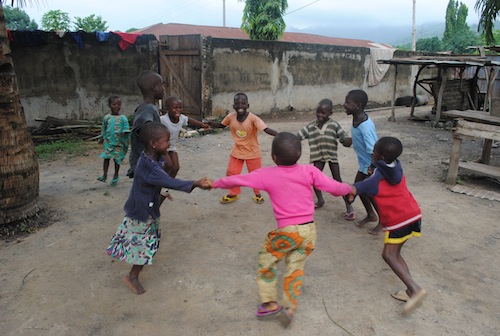
Ruben's plan was to take us to see another waterfall in the mountains of Kpime.  But first we had to stop in the village to meet his friend who would be our guide.  I didn’t really understand the details but we were early and he wasn’t ready, so we were to wait at his house until he came back.  No one was home except for one very pregnant woman making soup and 4 kids scrambling about.  Emily, Ruben and I sat in chairs against the wall feeling fairly awkward and intrusive, waiting who knew how long for this guide to come back.  I’ve already mentioned my inability to sit still, so after about I don’t know, a minute, I got up and approached the kids who were playing together in the courtyard.  As they hadn’t started learning French yet and my Ewe is a joke, we didn’t really have any method of communication between us.  So I did what any normal adult would do, I sprinted towards them and tagged one.  It wasn’t hard to catch on, and pretty soon I was playing tag with about 10 kids from the village.  Unsurprisingly they all conspired against me and I was the one who was perpetually “it”, which was fine because I think they got way more of a kick out of me chasing them than they did out of being chased by each other.  Soon Emily joined in as well and the two of us were sprinting through the village chasing cackling children, causing quite the commotion.  I noticed a couple of annoyed glances from some of their mothers because we were riling up their kids and getting in the way of their housework so I made the kids follow me back to the house and got out my camera.  
Togolese kids LOVE cameras.  They went nuts.  They started organizing a group photo shoot and ordered me around to take pictures of them in various poses. When I would show them their smiling faces on the display screen they would erupt with squeals of laughter and delight.  It was contagious.  But alas dad (our guide) came home, party was over, and all our new friends saw us off as we made our way to the waterfall, screaming our names and waving until we were out of sight.  


The “waterfall” was carved into the faraway mountain and it was about an hour walk to get to.  The walk and accompanying scenery were breathtaking we were on a tiny, winding dirt path with Togo’s signature greenery towering above and beyond us.  I have yet to get over how beautiful it is here. The waterfall was so peaceful, so cool, and even though the water flow was minimal because the electric company had blocked it to use for electricity purposes, it was still such a biophiliac experience.  


 I wish Togo could realize its potential for tourism. I think that westerners have the tendency to perceive the African continent in a series of lacks and failures, whereby travel here is limited to purposes of service and/or development.  I think most people in the west tend to see Africa in the obdurate and narrow terms of what we can offer them, rather than recognizing all that they can offer us.  I could be wrong and intensely naive, obviously I can’t speak for everyone in the western world but that was my general impression of my peers and community before coming here for myself.  
I have no intention, nor am I ready, to get into my own thoughts on development, that goes beyond the scope of this post, and I still need a lot more time to reflect, experience and gather my thoughts about this motherload of a topic.  But I think that the interplay between the artistic community and the tourism industry must be noted. Both the tourism sector and the craft sector enable developing economies to leverage their geography, culture and natural resources to support economic growth.  Specifically here in Kpalimé, the artistic community plays a large role in the commercial development of the town. That is why Nest’s work is so important here. By improving the efficiency and effectiveness of Chantal’s business while simultaneously expanding its impact and outreach to other disadvantaged youth in the community, Chantal can transform her batiking business into a full-fledged social and sustainable enterprise.  She can then directly contribute to the local economy by creating jobs, educating her apprentices with both financial and skill set training, and through generating interest in her traditional artistic craft by exporting to western markets, she can bring in more tourists.  While tourists currently have the opportunity to make their own batik with Aklala, in the future with a completed workshop Chantal would be able to offer organized, short-term classes to learn the crafts of the region, allowing for more cross-cultural experiences and collaboration, while also bringing in revenue for Aklala and for Kpalimé.  


I still have a lot more to say on the role that women artisans play in development but that can wait for later. Right now Elom is going to teach me how to drive his motorcycle.  Because I’m obsessed. I already know this isn’t going to end well, one time I flipped an ATV while in Mexico—who even knew that was possible. But as the great Harley Davidson once said, “Live to Ride. Ride to Live.”